SMS vs WhatsApp: Why Local Businesses Need Both — Just Not in the Same Place
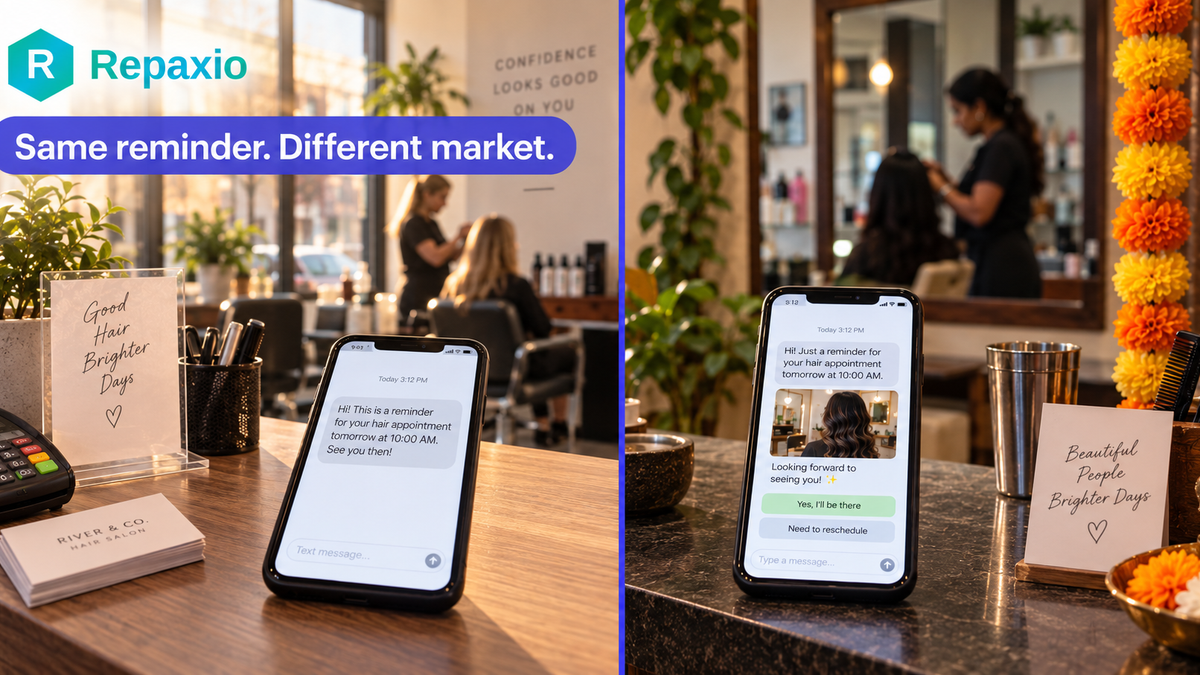
Quick answer: SMS and WhatsApp rarely compete for the same customer. In the US, texting is the default, and most people already opt in to business texts. In India, WhatsApp is: 91% of online adults message a business every week. You need both when your locations or customers span both markets, with each location on the channel its customers open.
Almost every guide ranking for "SMS vs WhatsApp" comes from a company that sells both channels. So they all reach the same verdict. SMS for alerts, WhatsApp for rich conversations, and ideally both, bought from them.
That's reasonable advice for an airline. It's the wrong starting point for a salon.
A local business doesn't choose a messaging channel off a feature list. Its customers have already chosen. A day spa in Austin and a day spa in Bengaluru can sell the same facial to the same kind of client, and the right way to send tomorrow's appointment reminder is still different in each city. Different channel, different rules, different setup before the first message goes out.
So the useful question isn't which channel is better. It's which one your customers live in, and what to do when the honest answer is "both."
Which channel do your customers actually use?
Start with the map. It settles most of the argument before features even come up.
In the US, texting is the habit. In EZ Texting's 2026 Consumer Texting Behavior Report, 89% of US consumers said they'd signed up for texts from a business, up from 66% five years earlier. Text was the preferred channel for appointment reminders (65%), and 87% said they check a new text within 15 minutes.
WhatsApp does have a real American audience, and it's growing. Pew Research Center's 2025 survey found 32% of US adults use it, up from 23% in 2021. But that audience is concentrated: Pew's full report notes that Black and Hispanic adults are more likely than White adults to use it. For most US local businesses, WhatsApp users are a slice of the customer base. Not the base.
In India, it flips. WhatsApp is simply where people talk to businesses. Citing a 2025 Kantar study, Meta says 91% of online adults in India chat with a business every week. SMS hasn't disappeared. For a local business, though, it has become the lane for OTPs, bank alerts and delivery codes: messages people glance at and swipe away.
That's the first problem with "SMS vs WhatsApp" as a debate. For a business in one country, the market already voted.
Why can't you just pick one channel for everything?
Because the rules underneath each channel are different, and in 2026 they're enforced.
US business texting runs on carrier registration. Since February 2025, AT&T, T-Mobile and Verizon block business texts from unregistered 10-digit numbers entirely, as IDT Express, a Tier-1 carrier network, lays out. Before your first review request goes out, your business and your intended use have to clear A2P 10DLC registration. TCPA consent rules and quiet hours sit on top of that.
Indian business SMS runs on a different registry, and it's tighter. Under TRAI's framework, any business sending commercial SMS has to register on a DLT platform, along with its sender headers and each message template, as Medianama explains. Promotional texts get scrubbed against the Do Not Disturb registry, and since October 2024 every link inside an SMS template has to be whitelisted, per Message Central's compliance guide. A salon owner in Pune who wants to text her Diwali offer isn't writing a message. She's filing a template.
WhatsApp plays by Meta's rules. Meta switched the WhatsApp Business Platform to per-message pricing on July 1, 2025. When a customer messages you, a 24-hour customer service window opens, and free-form replies and utility templates sent inside it aren't charged. Once the window closes, you can only reach out with a template Meta has approved. Meta has more pricing updates scheduled for August and October 2026, so check the current rate card before you budget.
Force one channel onto every market and you get the worst of each. Unregistered texts that never arrive. Indian promos stuck behind the DND filter. WhatsApp templates sent to American customers who don't have the app.
SMS vs WhatsApp: how do they compare for a local business?
SMSWhatsAppWhere it's the defaultUSIndia and many other non-US marketsWho can receive itAny mobile phone, no app or data neededPeople with the app and an internet connectionWhat you can sendShort text and linksText, images, documents, location and tap-to-reply buttonsSetup before your first business messageUS: A2P 10DLC brand and campaign approval. India: DLT registration of the business, sender ID and every templateA WhatsApp Business Account, plus Meta approval for each template you use to start a conversationReplying to a customerAny time, within consent and quiet-hour rulesFree-form replies only within 24 hours of the customer's last message; after that, approved templates onlyHow it's billedPer message through your SMS providerPer template message, by category and recipient country; free-form replies inside the 24-hour window are freeWhere it shines for a local businessReminders, review requests, "your table's ready"Booking changes, offers with photos, ongoing two-way chat
When does a local business actually need both?
Three situations. They're more common than the vendor guides let on.
- Your locations span two markets. Take a biryani brand with two restaurants in New Jersey and three in Hyderabad. The New Jersey stores should text. The Hyderabad stores should be on WhatsApp. And the owner wants every conversation, review and campaign in one view. That's "both" in its purest form, and it describes plenty of diaspora-rooted restaurant groups, salon chains, clinics and franchises.
- Your customers straddle two worlds. A barbershop in Queens might have a big group of regulars who live on WhatsApp. Given how uneven US adoption is, check your own customers before assuming either way: ask at checkout, or look at how people contact you today. If a real share prefers WhatsApp, the free WhatsApp Business app on the shop phone handles those one-to-one chats. Keep automated reminders and review requests on SMS, which every customer can receive.
- You're about to expand. Opening in another country? Settle the channel before you sign the lease. Collect the right consent for the right channel from the first customer, not after you've built a list you can't legally message.
If none of those describe you, you don't need both. You need the right one, set up properly. That's a complete answer.
How do you run both without doubling the work?
The failure mode is easy to spot. Two tools, two customer lists, two inboxes, and a manager checking four apps between appointments. A few rules keep it sane.
- Set the channel per location, not per campaign. Each location gets one default channel based on its market. Staff stop deciding message by message, and nobody texts a Hyderabad regular by accident.
- Keep one customer list, with consent recorded per channel. A yes to SMS isn't a yes to WhatsApp. Record which channel, when, and how the customer agreed.
- Write for the channel. A US reminder can be one tight line: "Hi Maya, your color appointment at Luxe Studio is Sat at 11am. Reply C to confirm or R to reschedule. Reply STOP to opt out." The WhatsApp version for Priya in Pune can carry her stylist's name, a photo of the studio entrance and two buttons: Confirm and Reschedule.
- Reply inside the 24-hour window. When a customer in India messages you, answer the same day. It's free, it's what they expect, and after 24 hours you're back to approved templates.
- Answer everything from one inbox. Whatever tool you use, replies from both channels should land in the same place, so two country managers aren't quietly running two separate businesses.
Where does Repaxio fit?
We built Repaxio's Engagement pillar around exactly this split. Every location runs on the channel its country uses: SMS through Twilio for US locations, WhatsApp through Meta's Business Platform for India and other non-US markets. Conversations from both come into one inbox, consent is tracked per channel, STOP requests are honored on either one, and campaigns can go out by SMS, WhatsApp or email.
A few specifics, since the rules above are where small businesses usually get stuck. For US locations, you fill in one registration form and Repaxio runs the A2P 10DLC steps behind it; approval timing is still up to the carriers. Campaign texts scheduled into US quiet hours wait until morning instead of going out. On WhatsApp, Repaxio tracks each conversation's 24-hour window, so free-form replies only go out while it's open.
One limit, stated plainly: Repaxio doesn't offer WhatsApp for US locations or SMS for Indian ones. The channel follows the location's country, which matches the market data above and keeps each location on the channel its customers actually open.
If your business spans both markets, or you're about to, see how it works on the Engagement page. We're onboarding a limited group of Founding Partners in the US and India.
Frequently asked questions
Is WhatsApp better than SMS for business?
Neither is better across the board. WhatsApp supports richer messages and free replies inside its 24-hour window; SMS reaches every phone with no app required. For a local business, the deciding factor is which one your customers use, and that's mostly SMS in the US and WhatsApp in India.
Do people in the US use WhatsApp to message businesses?
Some do. Pew found 32% of US adults used WhatsApp in 2025, with use concentrated in particular communities. Most US consumers still expect business messages by text: 89% have signed up for texts from a business, according to EZ Texting's 2026 survey.
Can a small business send SMS marketing in India?
Yes, but only after registering the business, its sender ID and each message template on a TRAI-mandated DLT platform, and promotional texts can't reach numbers on the DND registry. Most Indian local businesses find WhatsApp simpler for offers and reminders, because customers already message businesses there.
Is WhatsApp cheaper than SMS?
It depends on the message. Since July 2025, Meta charges per template message, with rates set by message category and the recipient's country, while free-form replies inside the 24-hour customer service window cost nothing. Chat-heavy businesses in India tend to benefit. For US customers, reach matters more than price, since most aren't on WhatsApp.
Do I need customer consent for SMS and WhatsApp?
Yes, on both. US marketing texts need prior consent under the TCPA and must honor STOP requests, and WhatsApp requires customers to opt in before a business messages them. Record consent separately for each channel; one doesn't cover the other.
Should a single-location business use both SMS and WhatsApp?
Usually not as two full programs. Pick the channel your market uses and run it well. If a meaningful share of your regulars prefer the other one, handle those one-to-one chats manually rather than building a second automated program.